—
What’s on
EXHIBITIONS, FAIRS, BOOKS, PRESS, TALK,...
V&A Dundee
EXHIBITION
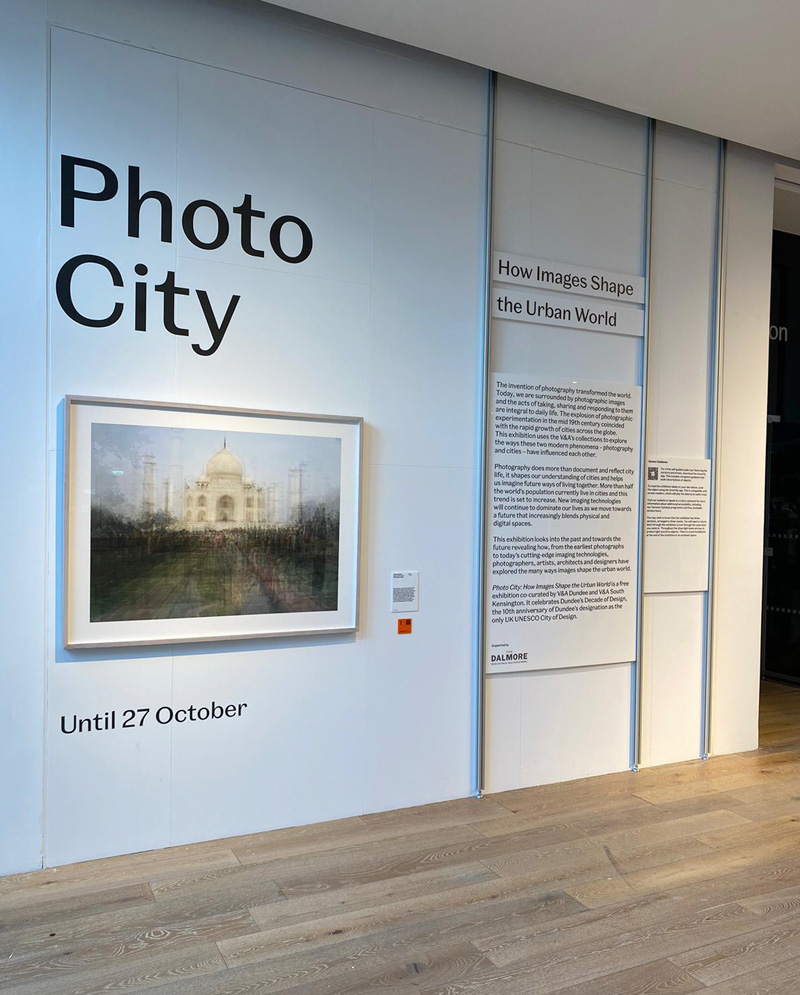
Photo City: How Images Shape the Urban World
Look through the lens at how photography frames the way we experience our cities
The invention of photography has transformed the world. Today, photographic images are everywhere and the acts of taking, sharing and responding to them are integral to daily life.
The explosion of photographic experimentation in the mid-19th century coincided with the rapid growth of cities across the globe. This exhibition brings together iconic images from the V&A’s collections as well as works by contemporary photographers, architects and digital artists to explore how photography and cities have influenced each other.
Diorama Map, Dundee by photographer Sohei Nishino is a large-scale photographic map of Dundee offering a captivating and intricate portrait of the city, through the eyes of the photographer.
(photo: Sohei Nishino)
︎︎︎ until October 20th, 2024
VIEW HERE
Musée Carnavalet, Paris
EXHIBITION
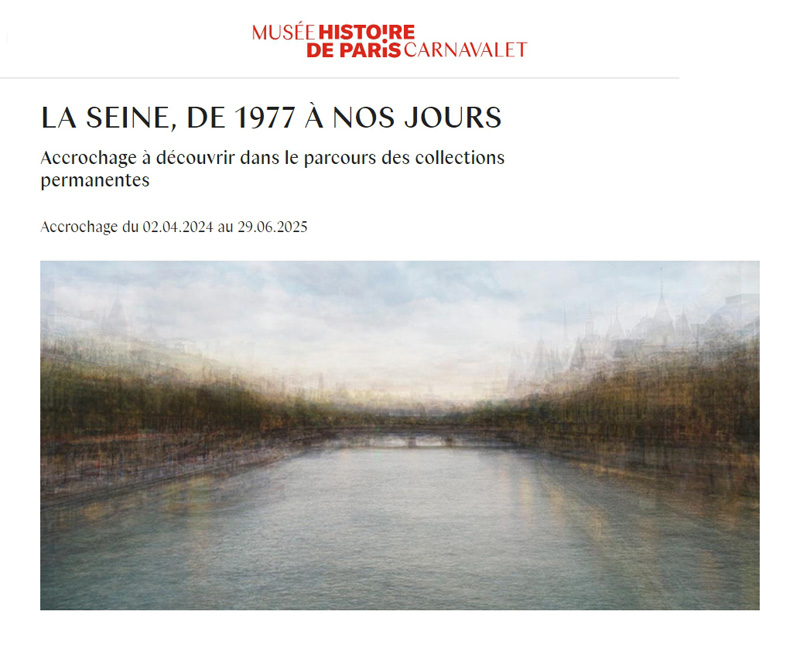
La Seine, de 1977 à nos jours
The Seine holds a special place in the history of the capital as well as in the life and in the fantasies of Parisians. On some 13 kilometers, 37 bridges connect its two banks. The most recent of them, the Simone-de-Beauvoir footbridge, was inaugurated in 2006. If the river shaped Paris, its uses changed and developed which also transformed it.
The Seine was used as resources, commercial axis, patrimonial space, and, increasingly as a place turned towards leisure activities, all the while remaining a natural site to be protected. In 1991, the banks of the Seine became a Unesco World Heritage Site: from the pont de Sully to the pont d’Iéna, on the right bank and until the pont de Bir-Hakeim on the left bank.
On this same bank, closed to cars in 2016, a 2.3 kilometers walk was built for pedestrians and cyclists, from the musée d’Orsay to the pont de l’Alma. The focal point of the 2024 Olympic Games, the Seine is, on this occasion, inaugurated by athletes as a place for swimming.
︎︎︎ until June 29th, 2025
VIEW HERE
Télérama
PRESS
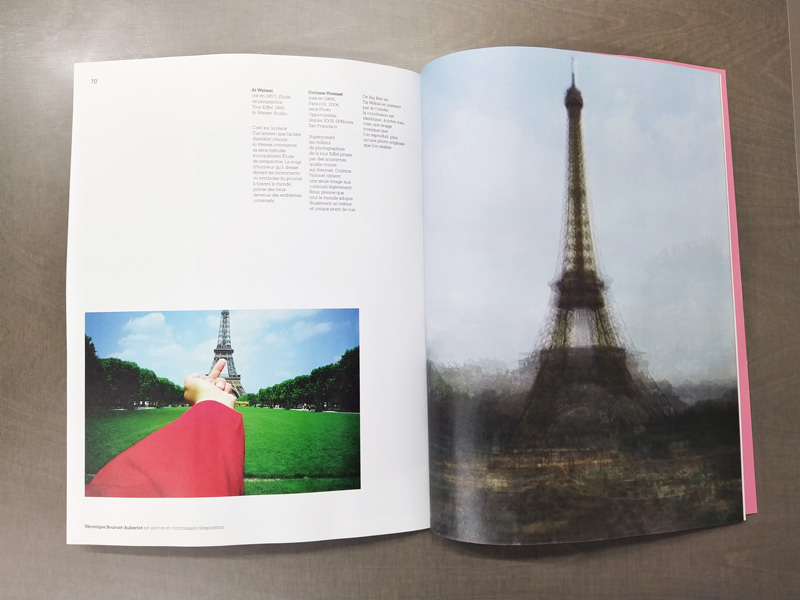
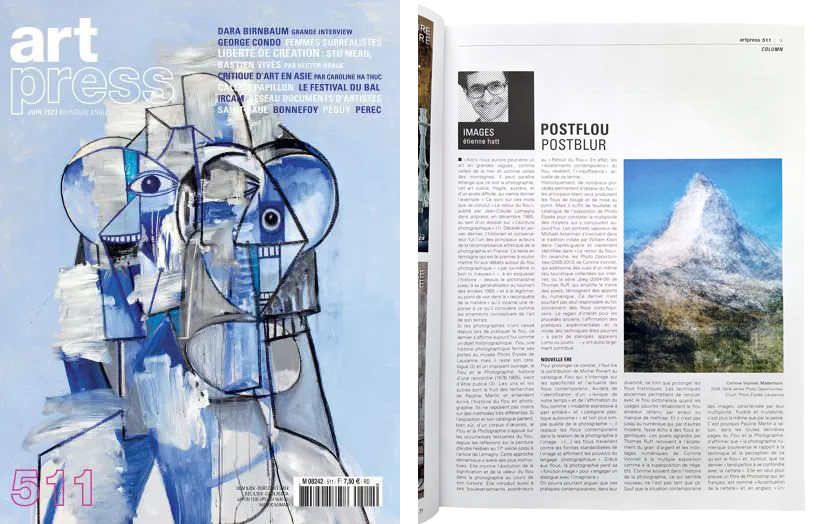
Eiffel — hors série, #244. November 2023.
(left image: Ai Weiwei / Etude de perspective. Tour Eiffel, 1995. Ai Weiwei Studio)
VIEW HERE
Almost There
ARTIST’S BOOK PUBLISHED BY RROSE EDITIONS
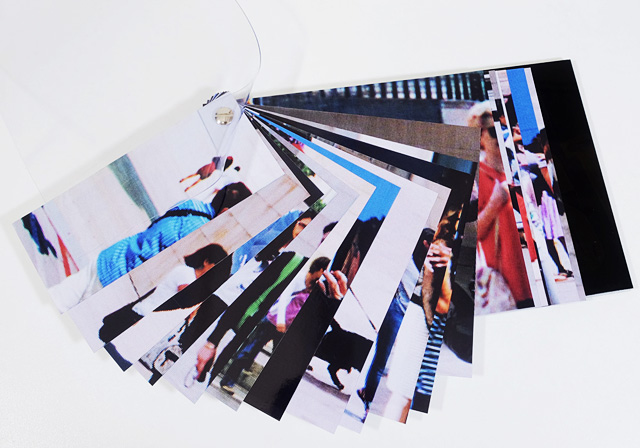
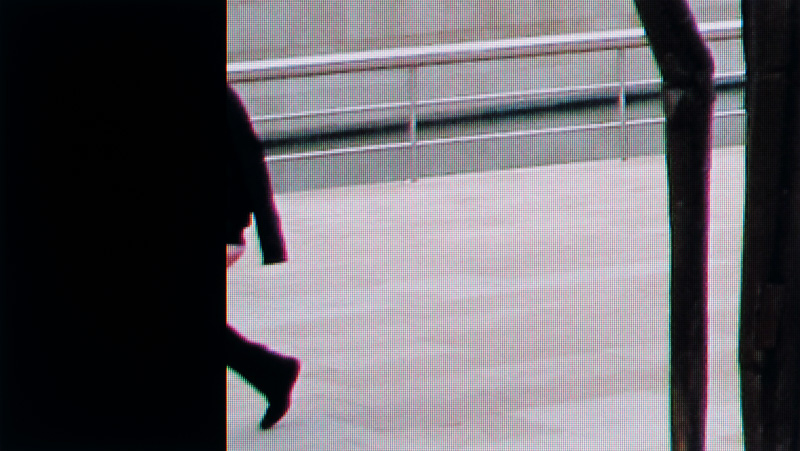
I'm very pleased to announce the launch of the book Almost There - my second collaboration with RRose Editions).
Almost There is created at the occasion of the commission art by Bilbao Metropoli-30 curated by Ramón Esparza, and exhibited at the Fine Art Museum in Bilbao.
This is a rather special edition, as all copies have been handmade, right from the artist's studio. For each book, 34 C-prints have been cut and assembled, around a black plexiglass core. Almost There acts as a portable exhibition, with a sculptural touch.
︎︎︎ 100 copies only. Hurry up!
VIEW + BUY HERE
Almost There
NEW WORK
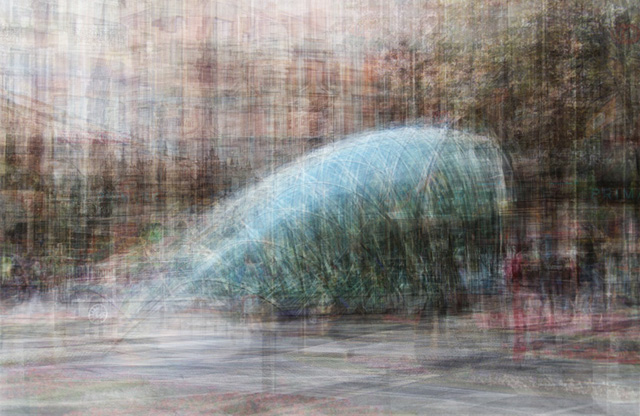
I'm pleased to announce my new work Almost There created at the occasion of the commission art by Bilbao Metropoli-30 and curated by Ramón Esparza. This work together with another one called What to See in Bilbao will be exhibited at the Fine Art Museum of Bilbao.
VIEW HERE
Museo de Bellas Artes, Bilbao
EXHIBITION
30-30-30 — curated by Ramón Esparza.
30 years after the Ría de Hierro exhibition, Bilbao Metropoli-30 and the museum have joined forces to show, once again through photography, a renewed image of the metropolitan area at the mouth of the Nervión. It is a smaller project but with the same spirit as the one that in 1993 gave an account of the state of an urban area that was witnessing the end of its industrial stage, with the main factories, installed on the edge of the estuary, closed or about to close. The one presented here presents, first of all, a gender difference, since three female views have covered the territory of the Lower Nervión. In addition, the images reveal the depth of social change experienced during these decades. Corinne Vionnet's vision of the city comes from social networks. And if we know that our knowledge of the world is largely constructed through images, her work raises the question of the dilution of the image in reality. Vanessa Winship and María Azkarate adopt more "conventional" points of view, focusing on the physical city - the urban fabric and its ruptures - and the human city, another of the poles of change in recent years. They show us that the vernacular city has become, like so many others in Europe, a potpourri of origins and languages.
︎︎︎ June14 – October 15, 2023
VIEW HERE
EXIT magazine - 89 - motion
PUBLICATION
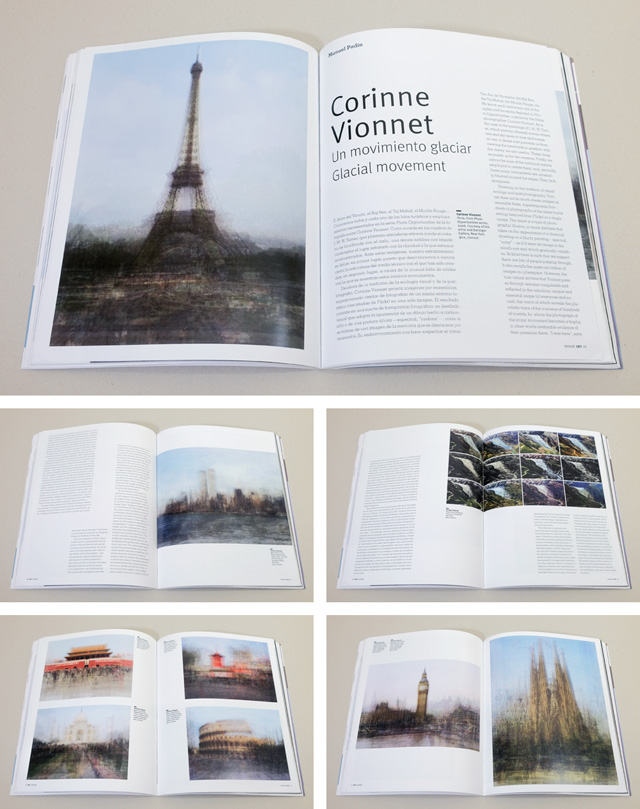
Un movimiento glaciar — Glacial movement — by Manuel Padín.
A popular phrase in the Spanish-speaking world, “El movimiento se demuestra andando” (“Movement is shown by walking”) is not exactly true because there are many differing views on the concept of movement. In Issue 89 of EXIT we take a look at some names – some of them very well established, some of them new – and provide examples of how photography strives to emerge from a state of motionlessness without moving, without ceasing to be a photograph. People, landscapes, the sky, the sea, nature, the city… Photography and photographers go to great lengths to subtly reveal the latent movement of life, of the world.
︎︎︎ 2023
VIEW HERE
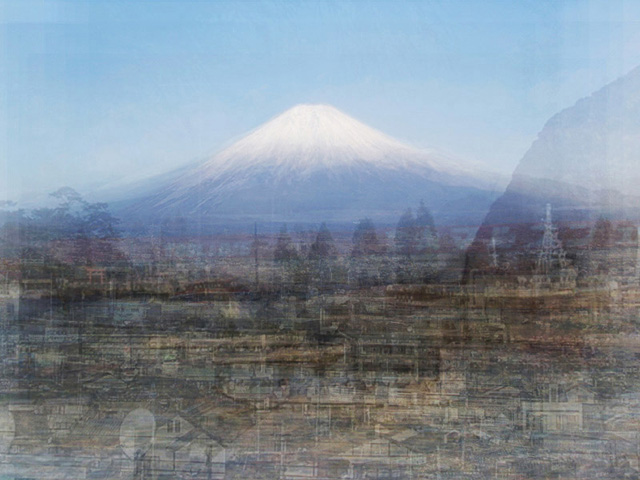
ALBERT KAHN MUSEUM, France
INAUGURAL EXHIBITION
Autour du Monde, La traversée des images, d’Albert Kahn à Curiosity — Around the World, Crossing images, from Albert Kahn to Curiosity — curated by Magali Mélandri, Clément Poché.
The inaugural exhibition of the Musée Départemental Albert-Kahn takes visitors on a journey to the origins of the "Archives de la Planète", offering a tour of the museum's collections and an exploration of representations of travel through photography and film from the beginning of the 20th century to the present day, with contemporary incarnations of works by Bernard Plossu, Catherine Hyland, Denis Roche, Corinne Vionnet, Marcus deSieno...
︎︎︎ April 2 – November 13, 2022
VIEW HERE

VISIONA, Huesca, Spain
EXHIBITION
Imaginarios colectivos: la construcción de la imagen turística — Curated by Pedro Vicente.
As part of the Visiona Huesca program, the exhibition Imaginarios colectivos: la construcción de la imagen turística (Collective Imaginaries: the construction of the tourist image) examines the importance of the use of images for the promotion of tourism and for the community and identity representation of the most visited places.
Artists: Perejaume, Oriol Vilanova, Corinne Vionnet, Sascha Pohle, Albert Gusi, Lucien Briet y Eduardo Nave as well as Kodak Coloramas and the collection of postcards "Same Sky Postcards".
(image of the exhibition: © Javier Broto)
︎︎︎ Feb 25 – May 15, 2022
VIEW HERE
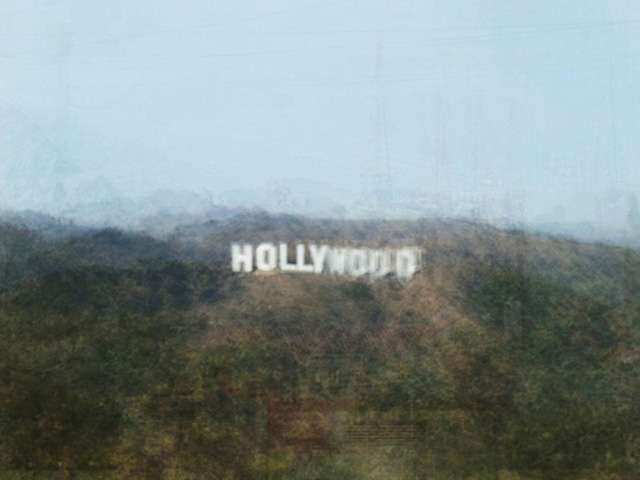
DANZIGER GALLERY, Los Angeles
EXHIBITION
Inaugural opening — Curated by James Danziger.
I'm so pleased to announce that Danziger gallery is opening its doors as its second location at Bergamot Station in Santa Monica! I have a special affection for Los Angeles and I am particularly delighted with this news.
Inaugural exhibition with following artists: Ansel Adams, Christopher Anderson, Richard Avedon, Hans Breder, Christopher Bucklow, Henri Cartier-Bresson, Thierry Cohen, Petra Cortright, Paul Cupido, André De Dienes, Robert Frank, Paul Fusco, Adam Fuss, Mario Giacomelli, Hisaji Hara, Evelyn Hofer, Seydou Keïta, Hendrik Kerstens, Karen Knorr, Jim Krantz, Michael Light, O. Winston Link, Glen Luchford, Alice Mann, Sally Mann, Pierre et Gilles, Yuji Obata, Tod Papageorge, Matthew Porter, Ulrike Rosenbach, Ian Ruhter, Alec Soth, Hiroshi Sugimoto, Risaku Suzuki, Ed Templeton, Ruud Van Empel, Corinne Vionnet, Andy Warhol, Brett Weston, Lloyd Ziff.
︎︎︎ Feb 19 – April 22, 2022
VIEW HERE
C4 JOURNAL
WRITING
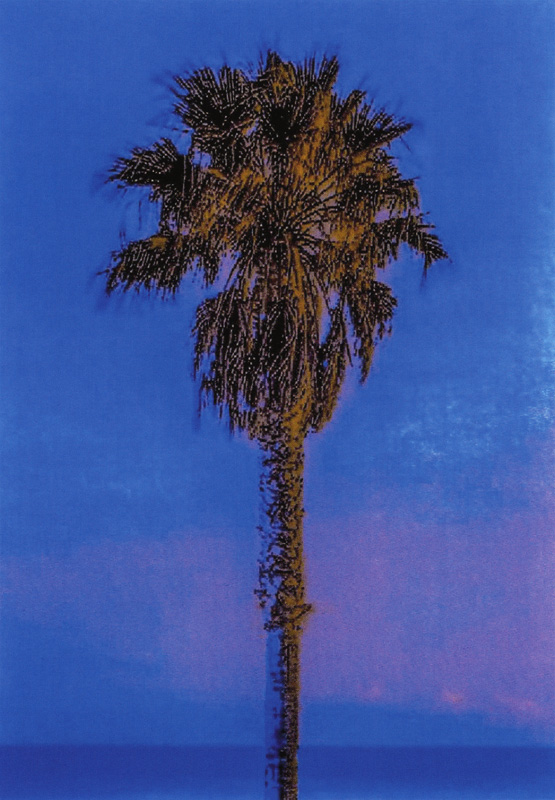
Paradise, Adulterated — By Eugenie Shinkle. Feb 17th, 2022
Paul Rousteau’s Seascapes and Corinne Vionnet’s Total Palm Tree.
Seascape: two basal planes of water and sky in symbiosis, drawn together at a horizon, proximate but never touching. An island, crystalline sand along the shoreline. Palm trees. Paradise, adulterated.
VIEW HERE
CHEFS-D’OEUVRE DU 21e SIÈCLE
PUBLICATION
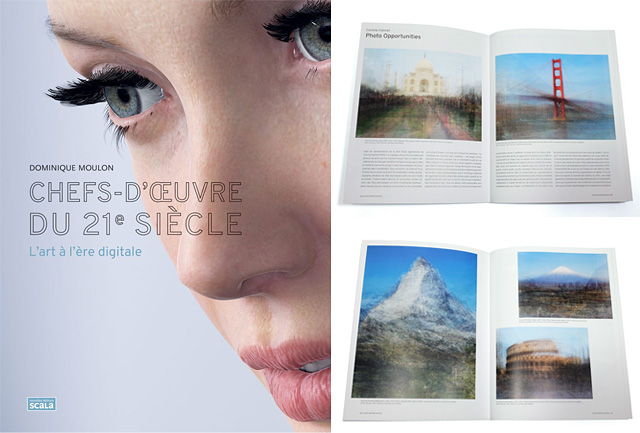
Chefs-d’Oeuvre du 21e siècle. L’art à l’ère du digitale [ 21st century masterpieces. Art in the digital age] — by Dominique Moulon.
Whereas the craftsmen of the Middle Ages completed their apprenticeships with the production of a masterpiece, in the 19th century, with the advent of the museum, the masterpiece took on its full dimension. The modern art avant-garde then diverted from it. However, this notion is re-emerging in the first quarter of the 21st century, and we can already take a critical look at it through the contemporary creations that illustrate it so perfectly. The fifty masterpieces gathered in this book are approached through the prism of contemporary issues raised by, among other things, our cohabitation with robots, the relationship we have with artificial intelligence, the flow of images and the processing of our data. For the masterpieces of the third industrial revolution, those that emerge from both the use and the critique of science and innovation technologies, offer us as many readings of today's digital world. Analyzing each creation allows us to consider what, possibly, makes it a masterpiece.
Artists : Memo Akten, Refik Anadol, Cory Arcangel, Ed Atkins, Renaud Auguste-Dormeuil, Adam Basanta, Valérie Belin, Émilie Brout & Maxime Marion, Grégory Chatonsky, Ian Cheng, Kate Cooper, Douglas Coupland, Heather Dewey-Hagborg, Disnovation.org, Pascal Dombis, Justine Emard, Félicie d’Estienne d’Orves & Éliane Radigue, Cao Fei, John Gerrard, Andreas Gursky, Michael Hansmeyer, Camille Henrot, Pierre Huyghe, Ismaël Joffroy Chandoutis, Eduardo Kac, Oliver Laric, Mark Leckey, Rafael Lozano-Hemmer, LuYang, Christian Marclay, Lauren Lee McCarthy, Katja Novitskova, Trevor Paglen, Julien Prévieux, Jon Rafman, Steve Reich / Gerhard Richter & Corinna Belz, Tabor Robak, Evan Roth, Rafael Rozendaal, Thomas Ruff, Arcangelo Sassolino, Michele Spanghero, Samuel St-Aubin, Jennifer Steinkamp, Hito Steyerl, Amalia Ulman, Penelope Umbrico, Corinne Vionnet, Sun Yuan & Peng Yu, Du Zhenjun.
Dominique Moulon is a professor in creative technology, independent curator and art critic. Holder of a PhD in Arts and Sciences of the Art, he is a member of the International Association of Curators of Contemporary Art (IKT) and the International Association of Art Critics (AICA).
VIEW HERE
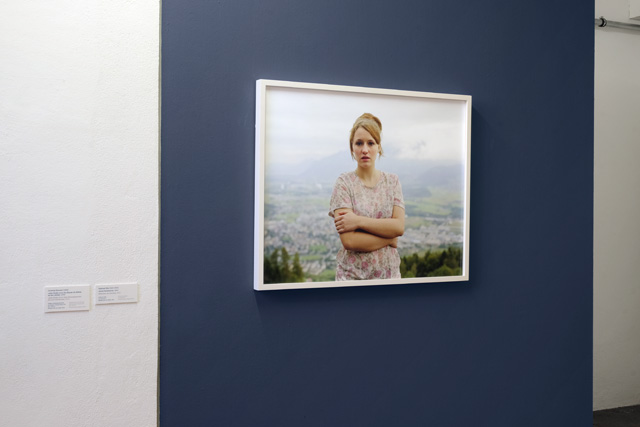
MUSEE D’ART DU VALAIS
Le Pénitencier, Sion, Switzerland
EXHIBITION
Raphaël Ritz Aujourd'hui — The exhibition "Raphael Ritz. Aujourd'hui", presented at the Centre d'exposition du Pénitencier des Musées cantonaux in Sion from October 16, 2021 to June 5, 2022, sheds a contemporary light on the work of this artist. The exhibition is structured by a selection of contemporary photographs signed by a dozen artists, such as Laurence Bonvin, Nicolas Faure, Yann Gross, and Corinne Vionnet.
I'm so pleased to announce that Danziger gallery is opening its doors as its second location at Bergamot Station in Santa Monica! I have a special affection for Los Angeles and I am particularly delighted with this news.
︎︎︎ Oct 16, 2021 – June 5th, 2022
VIEW HERE

TO BE DETERMINED
PUBLICATION
To be determined: Photography and the Future — by Duncan Wooldridge.
To Be Determined: Photography and the Future is a book with a radical proposal: the photograph is as much an object of the future as it is of the past. Exploring a familiar medium with new eyes, the book proposes that photographs’ technologies, processes, experiences and products, are in fact geared towards a world to come, and not a world that has been.
Written as a sequence of short interlinking essays, mixing ideas, studies of artworks, and the history of photography, To Be Determined takes its cue from Czech-born emigré philosopher Vilém Flusser, in its quest to reconceive the tools of photography and show how they inform and create the world around us.
Moving between contemporary photography and fine art, the book proposes that artists and photographers who question photography’s capacities – to transform our relationship to time, rewire our perception, and describe our encounters with technology – can also alter our understanding of the medium, and in turn, change our perception of our own agency, and our capacity to see, think and act.
Such an understanding of photography, Wooldridge suggests, has substantial consequences for the world beyond the image, and positions photography outside of study or observation and in a field of activity and experimentation.
Duncan Wooldridge (born 1981) is an artist, writer and curator. He received an MA in Photography from the Royal College of Art, and is course director for the BA in Fine Art Photography at Camberwell College of Arts, University of the Arts London (UAL). He is the author of John Hilliard: Not Black and White (Ridinghouse) and is a regular contributor to 1000 Words, Foam, and Over.
VIEW HERE
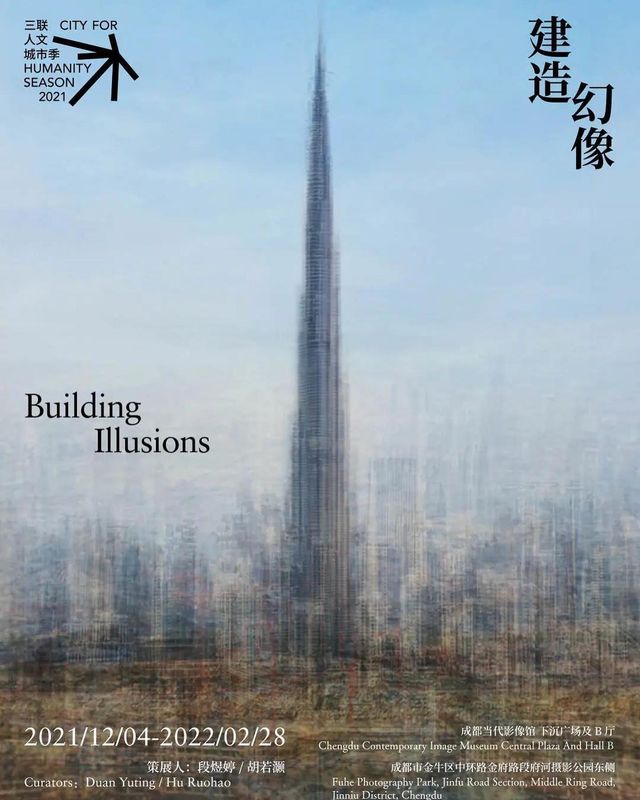
CHENGDU CONTEMPORARY IMAGE MUSEUM, China
EXHIBITION
Building Illusions — Curated by Duan Yuting and Ruohao Hu.
Participating artists: with Nadim Asfar, Yuanyuan Luka Yang, Corinne Vionnet, Claudia Jaguaribe, Birdhead, Pablo Lopez Luz, Michael Wolf, Richard Vijgen, Kurt Caviezel & ZHAW, Nación Rotonda, Cai Minhao, Ou Ning & Cao Fei, Borja Larrondo + Diego Sanchez, Atelier Guo.
︎︎︎ Dec 4, 2021 – February 28th, 2022
VIEW HERE

BOOK FAIR VOLUMES, Zürich
FAIR
VOLUMES 1 Day Christmas Edition — You can expect a day of books, zines, magazines with a couple of surprises in the super nice and caring space of Zentralwäscherei. There will also be food, drinks and music. This is the perfect opportunity to discover an exciting range of publications and find a few original presents!
Please come to meet us in Zurich during the fair. Rahel Zoller and I will be there!
MORE INFO HERE
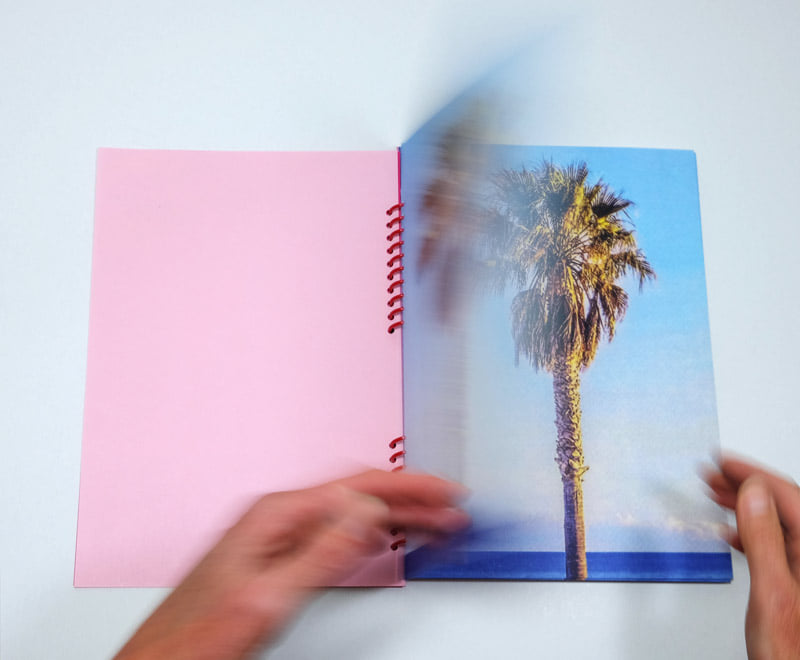
TOTAL PALM TREE
BOOK
Artist’s Book — The artist's book Total Palm Tree is now available and ready to be shipped by October 20th. Until October 20th, don't miss the opportunity to pre-order it at the launch price of €26.-. There are only 120 copies of this book!
Corinne Vionnet’s Total project is an examination of symbols, viewing them as they are transmitted and multiplied, and as they experience processes of transformation and collapse. Vionnet has located a small cluster of motifs, which she examines through processes of reproducibility - our media ecologies and systems of production and reproduction. [...]. In Total Palm Tree, a scanner and a postcard printing process exchange an emblem of exotic paradise, until it is both scorched and flooded on its way to disappearance. (Short extract - Duncan Wooldridge, 2021)
BUY IT HERE
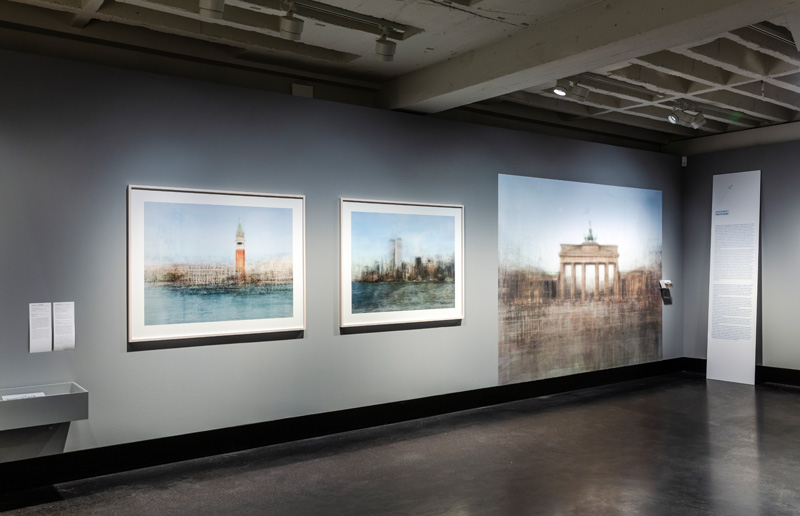
C|O Berlin
EXHIBITION
SEND ME AN IMAGE, From Postcards to Social Media — Photography has always been a social medium that has been shared with others. But why do people communicate with each other using images? And how do the “virtual distillates” of photographs change society? The thematic exhibition Send me an Image . From Postcards to Social Media outlines the development of photography from a means of communication in the nineteenth century to its current digital representation online. The focus is on the dialogue between historical forms of traveling images from photography over the past 150 years and contemporary artists from the 1970s onwards who work with both traditional and modern photographic techniques, uses, and means of communication.
Participating artists: ABC Artists' Books Cooperative, Adam Broomberg & Oliver Chanarin with Der Greif, David Campany & Anastasia Samoylova, Fredi Casco, Moyra Davey, Themistokles von Eckenbrecher, Martin Fengel & Jörg Koopmann, Stuart Franklin, Gilbert & George, Dieter Hacker, Tomas van Houtryve, Philippe Kahn, On Kawara, Erik Kessels, Marc Lee, Lynn Hershman Leeson, Mike Mandel, Theresa Martinat, Eva & Franco Mattes, Jonas Meyer & Christin Müller, Peter Miller, Romain Roucoules, Thomas Ruff, Taryn Simon & Aaron Swartz, Andreas Slominski, Clare Strand, Corinne Vionnet.
(image of the exhibition: © C/O Berlin Foundation, David von Becker)
︎︎︎ May 30 – August 4, 2021
VIEW HERE
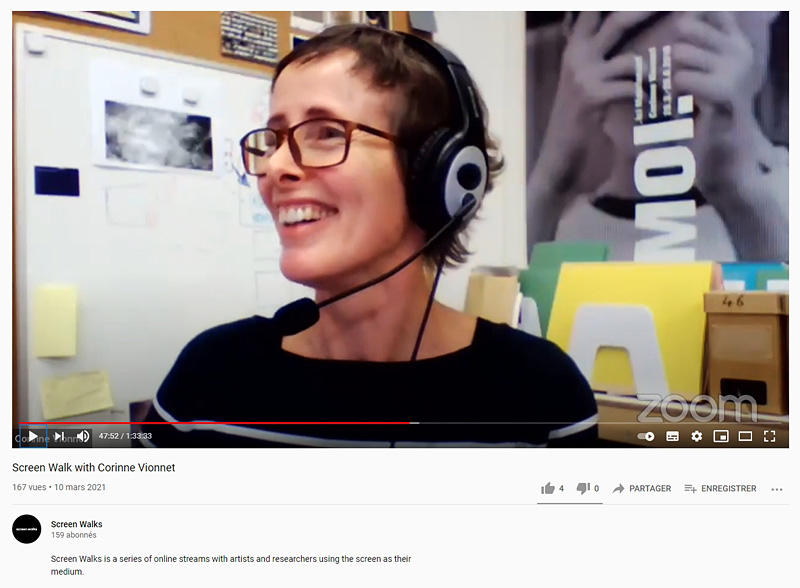
Screenwalks
TALK
ONLINE TALK — Online talk organized by the FotoMuseum, Winterthur and the Photographers' gallery, London
︎︎︎ 10 March 2021
VIEW HERE
In his analysis of Brave New World and 1984, cultural critic Neil Postman argues that it was Aldous Huxley who got the future right more than George Orwell. For, he writes, “Orwell feared that what we hate will ruin us. Huxley feared that what we love will ruin us.” In its own way, Vionnet’s work suggests it might be love that denies us an expansive, uniquely imagined world. Humane, open, and impersonal is a feel-good but problematic way of seeing — the hive mind’s eye, a glimpse of our collective, collapsing, hungry vision.
Hyperallergic _ Wonders of the World, Through the Lens of the Hive Mind, by Jeremy Polacek, February 5, 2015
Hyperallergic _ Wonders of the World, Through the Lens of the Hive Mind, by Jeremy Polacek, February 5, 2015
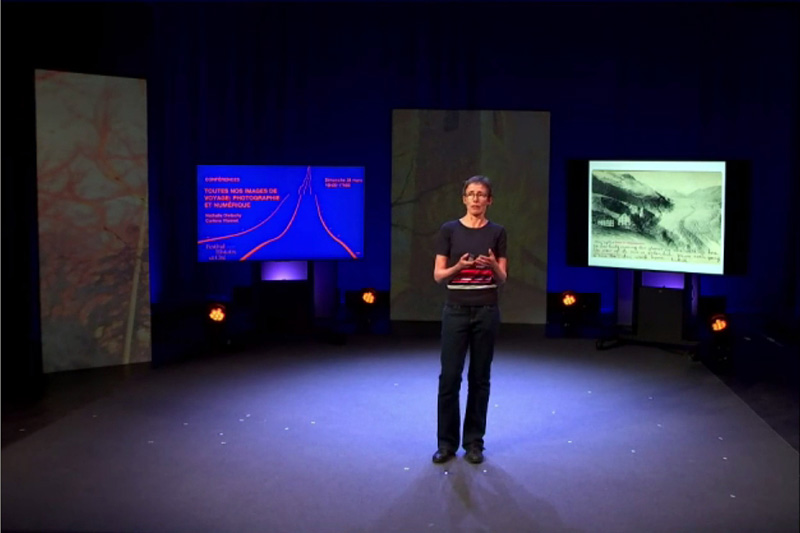
Histoire et Cité
TALK
Conférence— Dans le cadre de "Histoire et Cité", conférence en direct, le 28 mars 2021 avec Nathalie Dietschy. Modération par Diana Le Dinh.
Dans le cadre du Festival Histoire et Cité. www.histoire-cite.ch
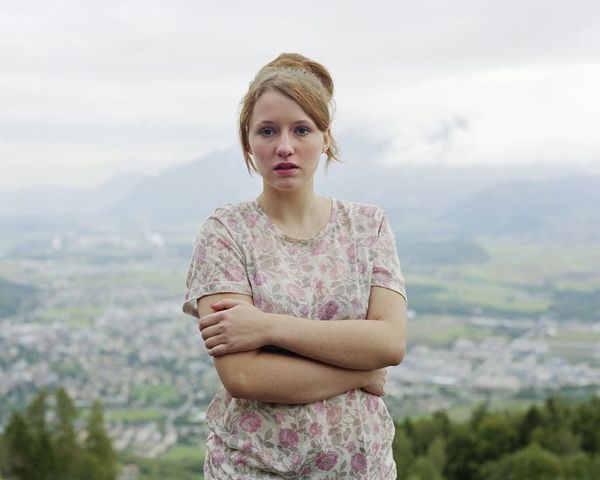
Museum acquisition
ACQUISITION
Musée d'art du Valais — When I was 35 year old, I decided to change completely my orientation and started visual art.
I started with two projects, 'Photo Opportunities' and a photo work titled 'From Rhone Glacier to Lake Geneva' that was a personal research into the county where I come from, walking along the Rhone river, from its glacier to the lake Geneva.
My work "Julie, Choëx, 2010" is today part of the collection of the Art Museum of Valais, along with the Rhoneglacier acquired a few years ago.
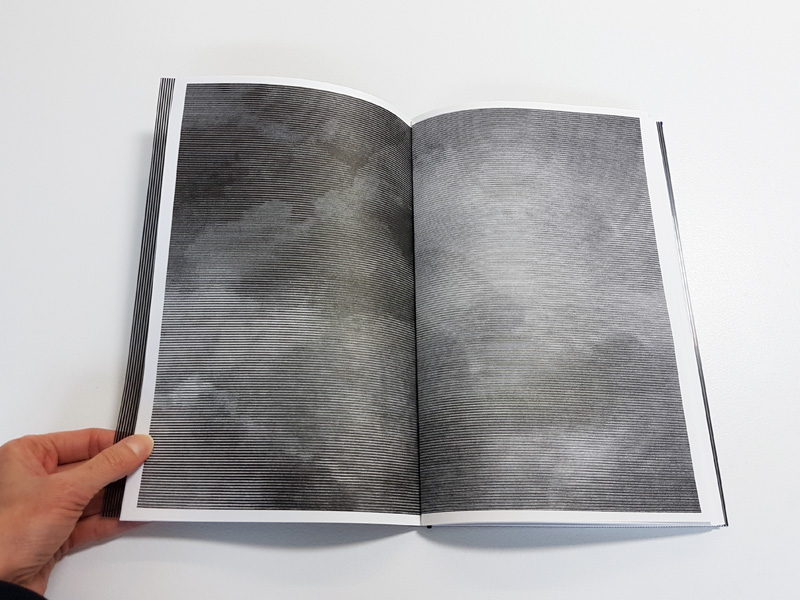
CIELS
BOOK
Collector Daily — by Loring Knoblauch
Photography criticism from a Collector's perspective
CIELS is a thoughtfully constructed photographic project which has been tightly coupled to its ultimate photobook form, using the book itself to activate the imagery in specific and controlled ways. Once again, Vionnet has cleverly uncovered intricate layers of complexity in a hackneyed subject, using a 21st century perspective to reinvent a photographic cliché.
(extract from Collector's Daily, Loring Knoblauch)
VIEW HERE
Click here to buy the book (15 books left!)
Click here for more info about the work CIELS
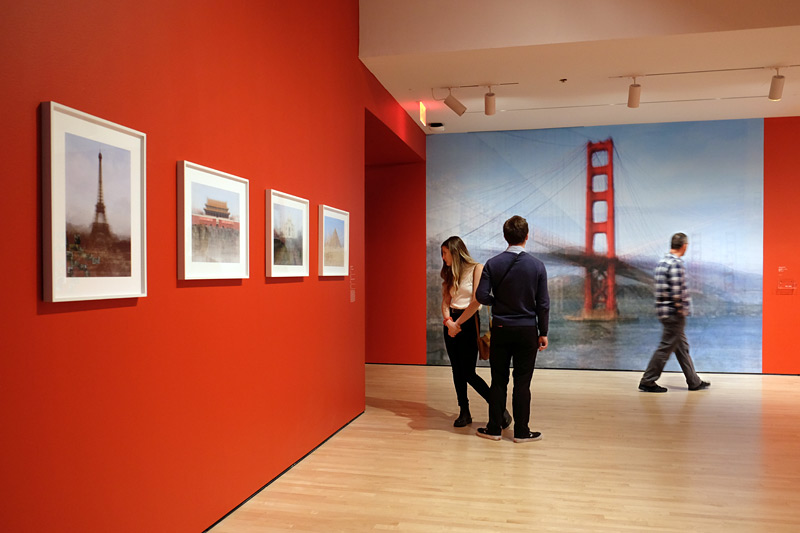
SFMOMA _ snap+share
EXHIBITION
MOMA OF SAN FRANCISCO — snap+sharetransmitting photographs from mail art to social networks
The exhibition snap+share gives visitors a new way to visualize — and experience — how photographs have become so ubiquitous in our daily lives. Whether through early examples of 1960s and '70s mail art, physical piles of pictures uploaded to the Internet over a 24-hour period, or a working refrigerator that allows participatory meme-making, visitors can trace the evolution of sharing photographs.
Spanning the history of mail art to social networks, the show presents a variety of artists working in various media, from framed paper-based art to immersive installations. Some of these artists include On Kawara, Ray Johnson, Moyra Davey, Erik Kessels, Corinne Vionnet, and David Horvitz. Exploring how networks are created through the act of sending images out into the world, this exhibition reveals just how those networks have changed in the age of the Internet.
My work Photo Opportunities will be part of the exhibitions snap+share at the SFMOMA.
︎︎︎ March 30 – August 4, 2019
VIEW HERE
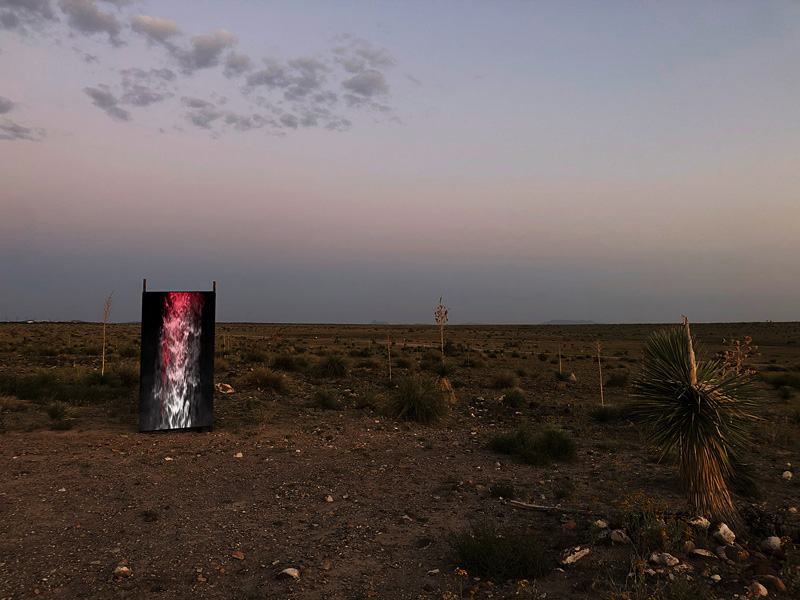
Maintenant art center, Marfa
EXHIBITION
Maintenant — Chinati Weekend
Join us on Friday October 9 & Saturday October 10 for a Drive-Thru Art Safari @ Maintenant, 23 Antelope Hills Rd - Marfa
Artworks by Natalie Melendez, Matt Scobey, Carlos García-Noriega Bueno, Dawn Kim, Corinne Vionnet & Laurent Pavy
-
Video 'The Fall' - collaborative work with Laurent Pavy - at Maintenant art center in Marfa/TX.
VIEW HERE
The durably exciting thing about Vionnet’s Total Flag [work] is that it can be read equally well on two distinct levels. It is both a meticulous artistic study of the effects of iterative image recursion and an archly biting roadmap of the where America might be heading, its abstractions just open-ended enough to allow us to extend the visual evidence of the experiment into a searing visual metaphor for national degradation. Constructing such smart artistic duality isn’t easy, especially using such a simple organizing device. Total Flag is just what it needs to be and no more – an incisive mixture of technology and artistic thought that alternately delivers both beauty and horror. By Loring Knoblauch / about the book Total Flag (link)